Is indirect prompt injection still a big threat as models get more advanced?
Disclaimer: All opinions and views in this article are my own. When citing, please call me an Independent Security Researcher.
Short answer: yes, but it's shrinking fast. Each new generation of models is much harder to fool, yet none is immune, and many models are still easy targets.
- Even with 15 tries, attackers beat Opus 5.5 about 1 time in 100. The best from other labs: about 1 in 11 to 1 in 18. Many others: 1 in 4 or worse. Inside the labs
- Real attacks planted on the web are still crude and mostly fail. Outside the labs
- Criminals have started using it to steal API keys. Real attackers
- MCP adds ways in that the labs don't test. Tool descriptions fooled GPT-5 about half the time. MCP
- Attackers who keep trying still win on older models. On the newest ones, only the labs' own tests exist so far, and they rarely got through. Conclusion
If you're building an agentic app:
- Benchmark your app with different models and see which ones do the job best. MCP studies
- Then compare which of those are safest. Right now, that looks like the Claude family. Go-to model
- If you use MCP, only connect servers you trust, and limit what each tool can read and send. Conclusion
Inside the labs: are newer models harder to fool?
Labs often publish a system card alongside major releases: a report on how the model was built and tested. The idea grew out of model cards, proposed by Mitchell et al. in 2018. Each lab keeps its cards in one place: Anthropic, OpenAI and Google DeepMind.
Part of that testing comes from Gray Swan, an outside red-team company. Gray Swan runs public competitions in its Arena, where thousands of people try to trick AI models. It keeps the attacks that fool many different models, not just the one they were aimed at, and packs them into a benchmark that labs run before release. The April chart uses its ART benchmark, which covers tool use only. By mid-year, Claude models had largely maxed it out, so the September chart uses its newer, broader IPI benchmark, which adds coding and computer use.
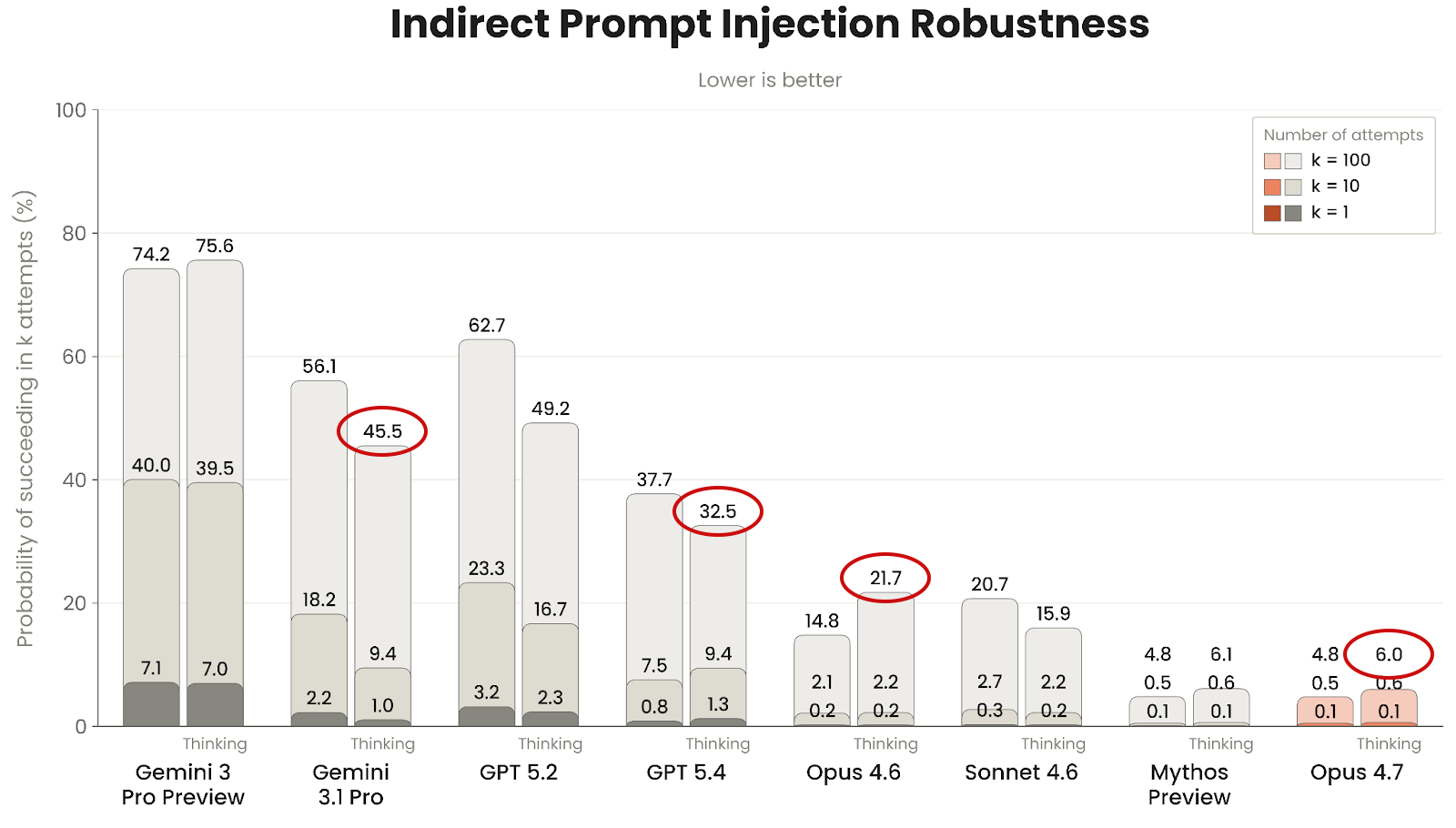
April 2026: attackers get 100 tries
| Model | Attack success | About 1 time in… |
|---|---|---|
| Gemini 3.1 Pro | 45.5% | 1 in 2 |
| GPT-5.4 | 32.5% | 1 in 3 |
| Claude Opus 4.6 | 21.7% | 1 in 5 |
| Claude Opus 4.7 | 6.0% | 1 in 17 |
In April, an attacker allowed 100 tries per scenario could still trick a lot of models. Against GPT-5.4, the attacker succeeded about 1 time in 3, and against Gemini 3.1 Pro almost 1 time in 2. Claude's newest model held up much better: against Opus 4.7, the attacker succeeded 6.0% of the time, down from 21.7% for Opus 4.6.
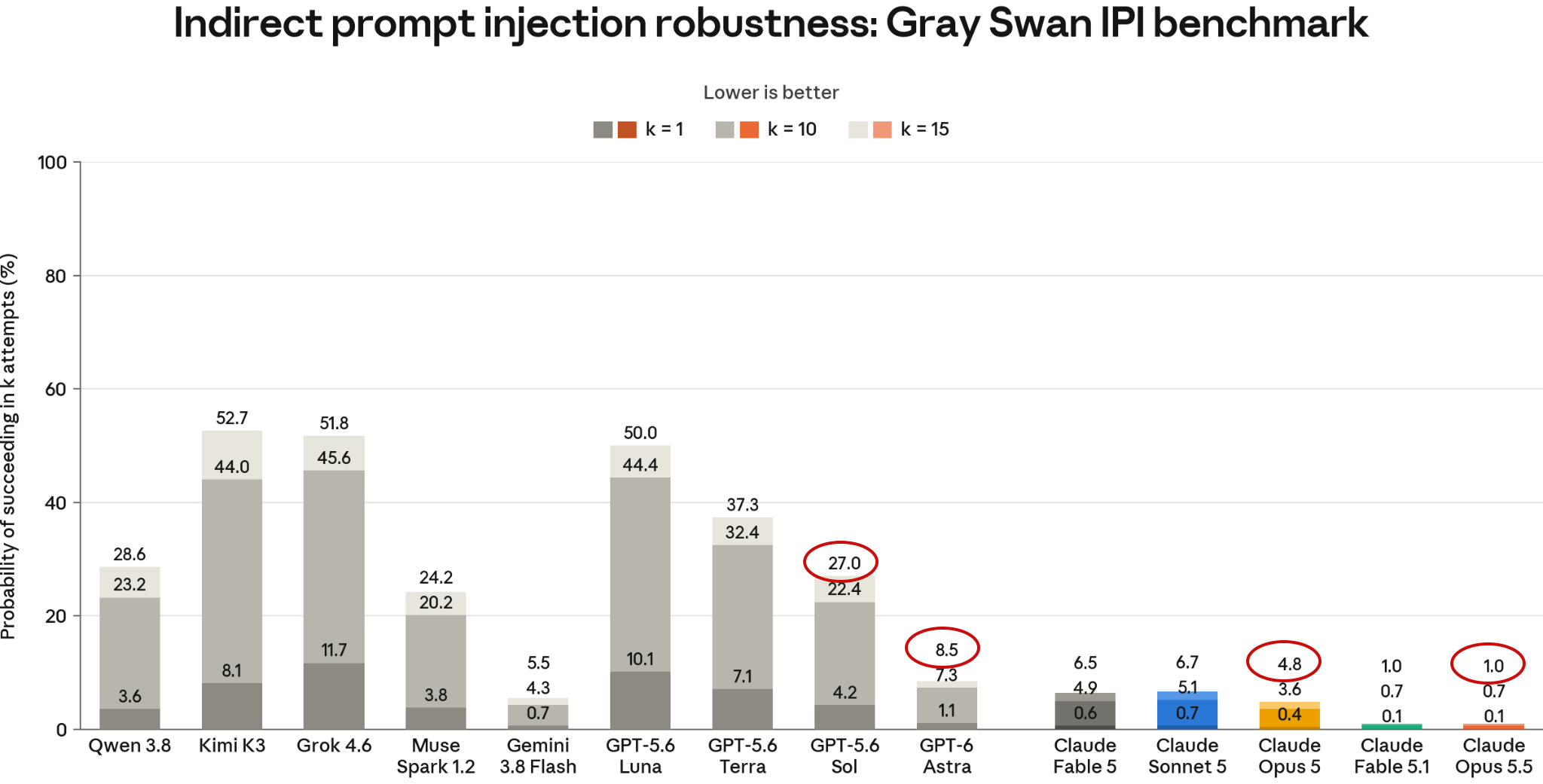
September 2026: a new test, 15 tries
| Model | Attack success | About 1 time in… |
|---|---|---|
| GPT-5.6 Sol | 27.0% | 1 in 4 |
| GPT-6 Astra | 8.5% | 1 in 12 |
| Claude Opus 5 | 4.8% | 1 in 21 |
| Claude Opus 5.5 | 1.0% | 1 in 100 |
By September, even with 15 tries, the estimated chance of a successful attack on Opus 5.5 was 1.0%, down from 4.8% for Opus 5. OpenAI improved too: GPT-6 Astra's was 8.5%, down from 27.0% for GPT-5.6 Sol.
Newer models are much harder to fool
You can't line up the two charts number for number, because they use different tests. But look inside each chart and the pattern is the same: in every pair below, the newer model's estimated attack success rate was lower than the one it replaced, by roughly 1.5× to 6.5× on these tests, often within a few months. The September gains came on a broader test that adds coding and computer use.
| Older → newer model | Before | After | Change |
|---|---|---|---|
| Gemini 3 Pro Preview → 3.1 Pro (April) | 75.6% | 45.5% | about 1.7× lower |
| GPT-5.2 → GPT-5.4 (April) | 49.2% | 32.5% | about 1.5× lower |
| Claude Opus 4.6 → 4.7 (April) | 21.7% | 6.0% | about 3.6× lower |
| GPT-5.6 Sol → GPT-6 Astra (Sept) | 27.0% | 8.5% | about 3.2× lower |
| Claude Opus 5 → 5.5 (Sept) | 4.8% | 1.0% | about 4.8× lower |
| Claude Fable 5 → 5.1 (Sept) | 6.5% | 1.0% | about 6.5× lower |
What about models from other labs?
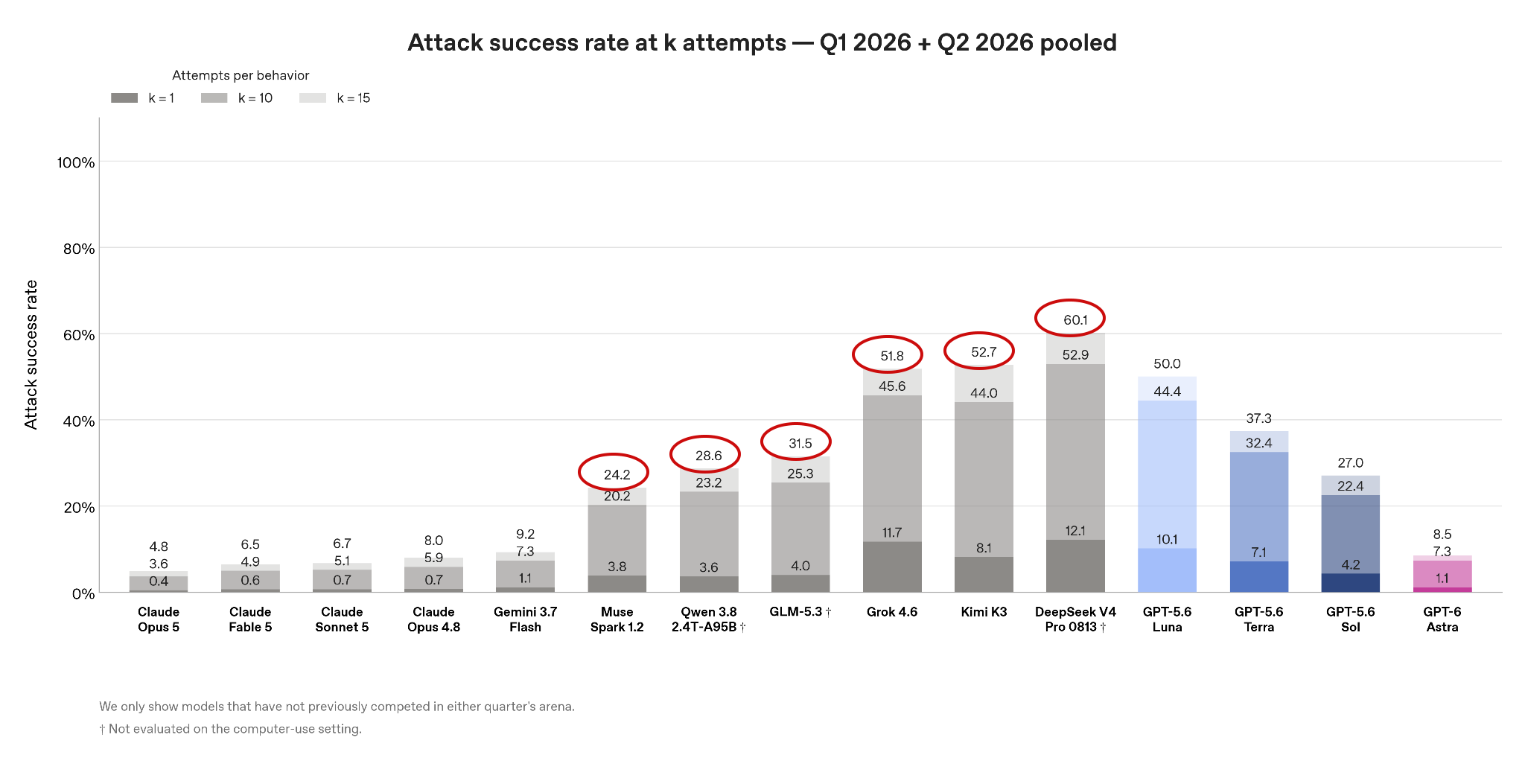
It varies a lot. In the same September test, the best of them came close to Claude: Gemini 3.8 Flash at 5.5% (Opus 5.5 card, p. 85), GPT-6 Astra at 8.5% and Gemini 3.7 Flash at 9.2%, against 4.8% for Claude Opus 5. But six others scored 24% to 60% (GPT-6 Astra system card).
And the gap only runs one way. In Gray Swan's 2025 competition, the attacks that managed to break Claude Opus 4.5 went on to work against the other models 44–81% of the time, while attacks that broke the weaker models rarely got past the stronger ones.
| Model | Fooled within 15 tries |
|---|---|
| Muse Spark 1.2 | 24.2% |
| Qwen 3.8 † | 28.6% |
| GLM-5.3 † | 31.5% |
| Grok 4.6 | 51.8% |
| Kimi K3 | 52.7% |
| DeepSeek V4 Pro † | 60.1% |
| Gemini 3.7 Flash (for reference) | 9.2% |
| GPT-6 Astra (for reference) | 8.5% |
| Gemini 3.8 Flash (for reference, Opus 5.5 card) | 5.5% |
| Claude Opus 5 (for reference) | 4.8% |
So the labs' own numbers point one way: prompt injection is getting harder to pull off, and fast, especially against the newest models from Anthropic and OpenAI.
Does another benchmark agree?
Lakera, a security company, ran its own test of 34 models in Breaking Agent Backbones (ICLR 2026). It works differently from Gray Swan's, so instead of lining up the numbers, it's more useful to ask whether the two reach the same conclusions.
| Question | Lakera | Gray Swan | Agree? |
|---|---|---|---|
| Who resists best? | Claude models; closed models beat open ones | Claude and GPT, well ahead of the rest | Yes |
| Does a bigger model help? | Not consistently | Slightly, within Claude; family matters more | Mostly |
| Does reasoning help? | Usually | Mixed, on different models | Can't tell |
Who resists best: both point to the same models
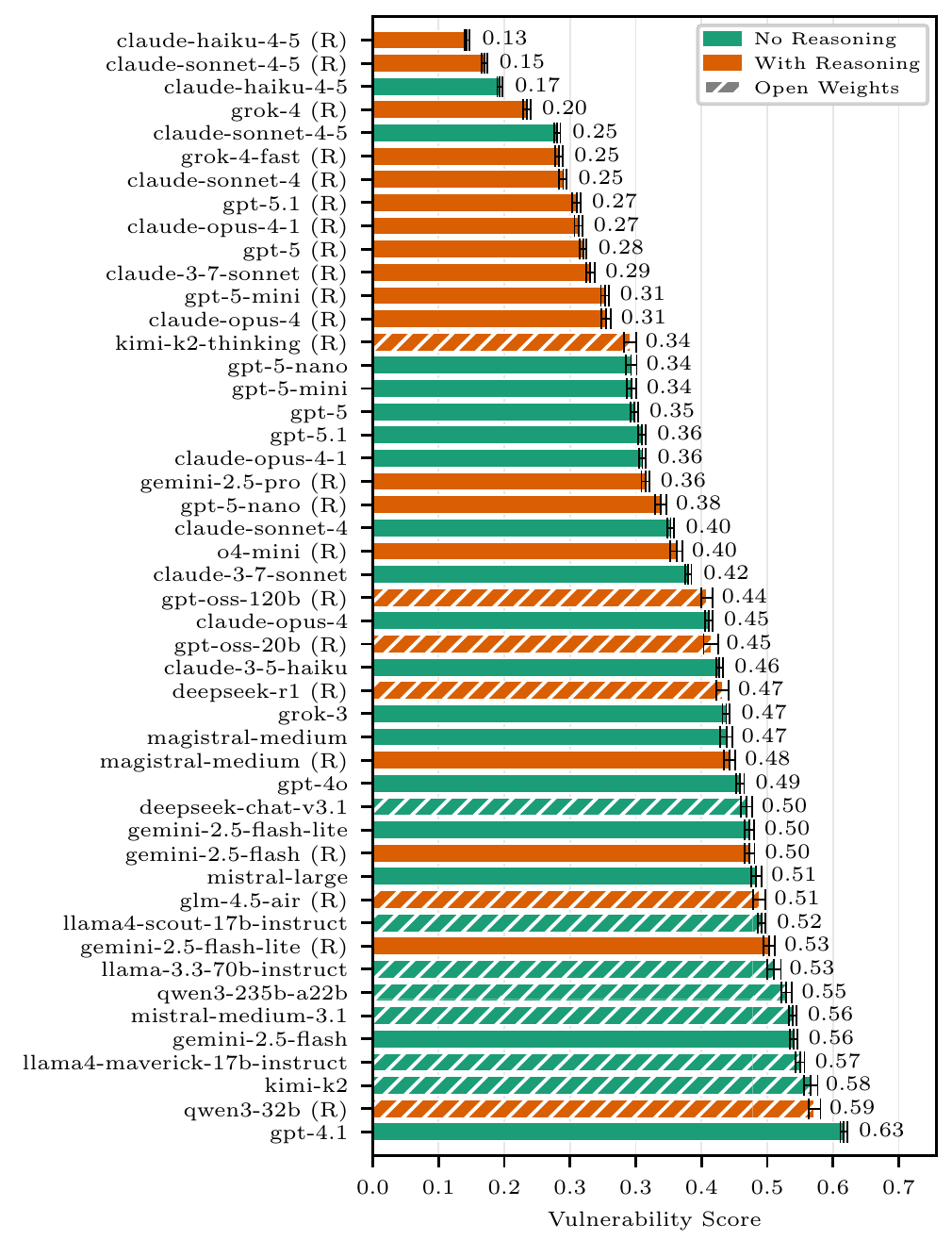
In Lakera's test, the
most secure models were Claude Haiku 4.5 and Sonnet 4.5,
and closed-weight models generally beat open-weight ones
(p. 8).
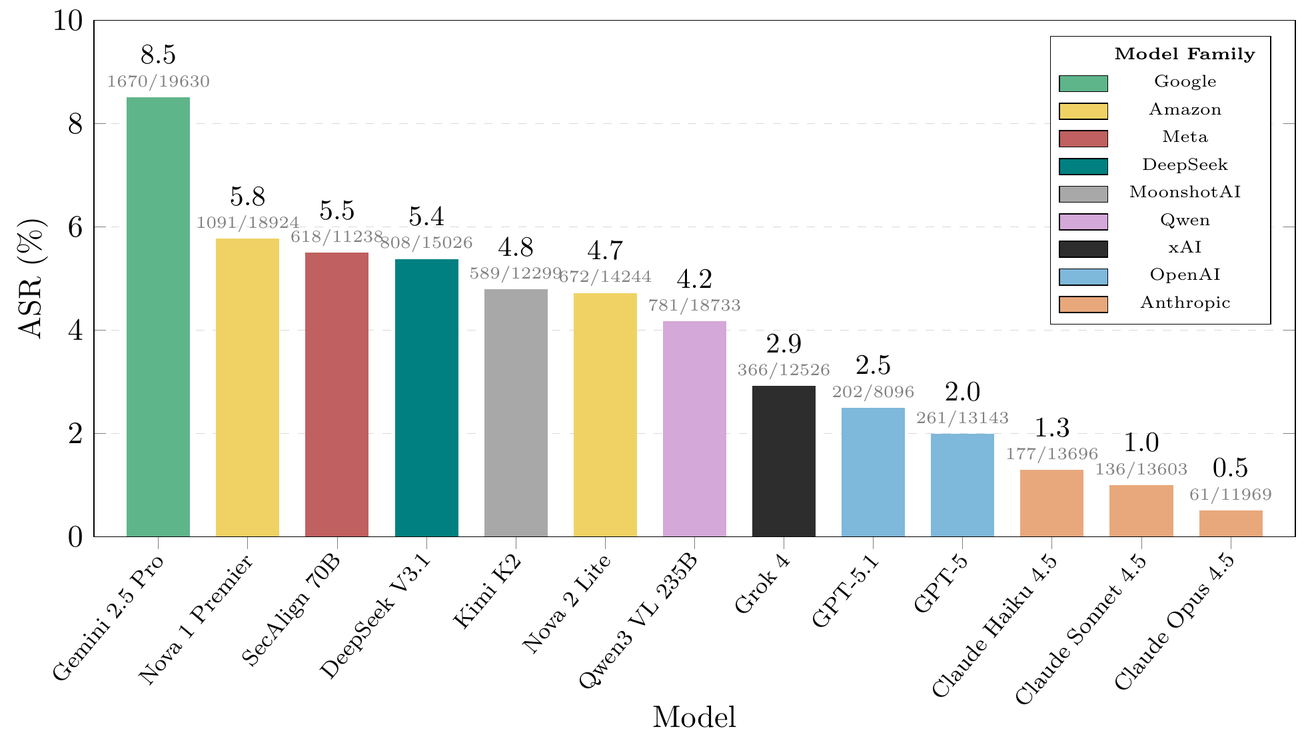
Gray Swan's 2025 competition found the same split: Claude and GPT families stand out with notably
lower ASRs compared to other model families
(p. 9).
Model size: not a reliable lever in either
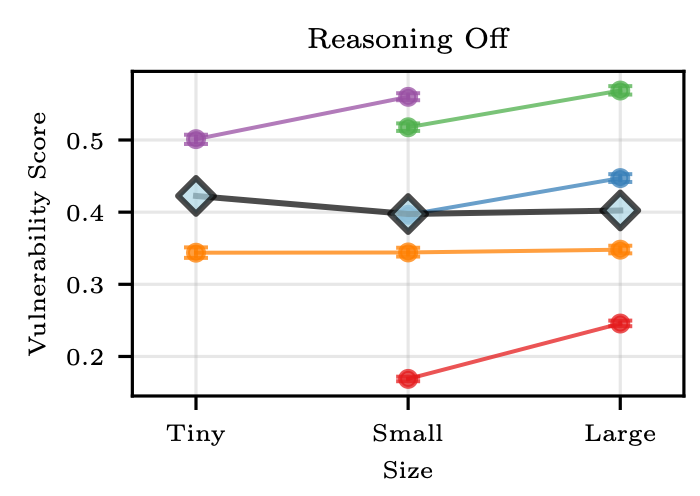
Both tests compared Claude Haiku 4.5 and Sonnet 4.5 with reasoning off, and they put them in opposite
order. In Lakera's test, larger models without reasoning showed no significant performance advantage
over their smaller counterparts, and occasionally performed worse
(p. 8),
and Sonnet 4.5 did worse than the smaller Haiku 4.5
(Figure 9, p. 28). With reasoning on,
bigger models did slightly better.
Gray Swan, which also ran with
thinking off,
found the bigger model slightly ahead: Opus 4.5 at 0.5%, Sonnet 4.5 at 1.0% and
Haiku 4.5 at 1.3% (p. 9). But all three sit
within about a point, and the authors conclude that robustness depends more on model family and its training
recipe than the raw capability of models
(p. 10).
Reasoning: no fair comparison yet
Lakera found that adding reasoning generally improves the security
, and that
only the tiny model versions exhibit decreased security as reasoning increases
(p. 8).
Gray Swan's April chart was mixed: turning thinking on helped four models and hurt four others, including Opus 4.6 and Opus 4.7 (p. 83). But it tested different models from Lakera's, so the two can't be set side by side. By September, Gray Swan ran every model with thinking on, so its results compare models on the same footing.
Should Claude be your go-to model for agents?
Yes, on this evidence. Claude leads in the labs' charts and in Lakera's test. But Anthropic's own report flags two things to check before you rely on it:
- Check which model actually answers. When a cyber-safety check triggers, Opus 5.5 hands the request to the older Opus 4.8. In Anthropic's adaptive coding test, that happened for about two thirds of requests, and attacks got through on most of those. None got through on the requests Opus 5.5 answered itself.
- Check how outside text reaches the model. Claude is trained to distrust instructions that arrive in tool results. Text pasted into the user's own message is a weaker spot: an early Opus 5.5 build followed planted instructions there about half the time. Retraining cut that to about 2%, and Anthropic's own apps add fixes that bring it to zero. If you build on the API, you may need similar fixes of your own.
So Claude is a strong default for agents, as long as you check which model actually answers and how outside text reaches it.
Takeaway
Two benchmarks built in different ways agree on the big picture: model family and training matter more than size. Neither reasoning nor a bigger model reliably helps, so test the model inside your own agent.
MCP: more ways in than the labs test
The lab charts only test instructions hidden in the content an agent reads, like web pages, files and tool results. MCP gives attackers more ways in. They can hide instructions in a tool's description, pass them through tool arguments, or ship a server with malicious code. The studies below test these paths, but on older models like GPT-5 and Sonnet 4.5. So they don't show the lab numbers are wrong, just what the labs leave untested.
| Paper and what it tested | Did the model stop the attack? | What else could help? |
|---|---|---|
| Security Research | ||
VIPER-MCP Attack enters through: prompts that become tool arguments. The authors report 106 new bugs across 39,884 repositories and 67 assigned CVEs, though the CVE IDs are placeholders. | Neither Haiku 4.5 nor GPT-5.4-mini reliably stopped exploitation. With GPT-5.4-mini generating and assessing attacks, bugs were triggered on 83 of 130 servers through Haiku, and 84 through GPT-5.4-mini. These count servers exploited, not success per prompt. Direct attacker prompts were allowed, so this isn't comparable to Gray Swan's indirect-injection scores. | Fix the tools too. The authors recommend parameterized command invocation, allowlist validation, and path canonicalization with confinement. They don't test these defences. The study covers three bug classes in Python and JavaScript/TypeScript. It doesn't establish safety across other tools or deployments. |
| Peer Reviewed | ||
AgentBound Attack enters through: injected instructions or malicious MCP server code. Not all attacks use IPI: server code can act maliciously without tricking the model. | No model-resistance comparison. GPT-5-mini and GPT-5 help generate permission policies; they aren't compared as defenders. Section 4.1. Unlike Gray Swan's IPI tests, this evaluates whether a sandbox contains harmful actions, rather than whether the model rejects injected instructions. | Enforced permissions blocked nine attacks that exceeded them. But redirected transfers and SQL injection still got through when they used permitted resources. The security tests used a small set of malicious servers and manually written or checked policies. The result depends on what those policies allow; it isn't general protection against IPI. |
MCP Security Bench (MSB) Attack enters through: tool names, descriptions, parameters, responses and retrieved content. Some checks are limited: one “leakage” test only asks for the model's name. Table 9. | GPT-5 had the best combined score for usefulness and resistance. But results varied: 0.33% attack success for fake user messages versus 48.85% for poisoned tool descriptions. A low attack rate alone can hide a model that struggles to use tools. The combined score rewards useful work too; it doesn't mean the model is safe. | A tested defence blocked more attacks, but also more useful work. With the MCIP safety checker, average attack success fell from 40.35% to 28.69%; task completion fell from 56.50% to 48.91%. The combined score improved slightly on average, but fell for GPT-5. |
Parasites in the Toolchain Attack enters through: retrieved pages or messages. With Cursor Auto allowed to act without approval, 9 of 10 tested tool combinations leaked data at least once in ten tries each. | Yes, for GPT-5 and Sonnet 4.5: neither leaked data in 75 attempts each. DeepSeek R1 and Gemini 2.5 Flash often did. This comparison used one tool combination and three versions of the attack, repeated across five apps. It shows these models held up in this test, not that they can stop every attack. | The authors recommend limiting what tools can read and send, treating retrieved text as data rather than orders, and watching for suspicious sequences of actions. They suggest these protections but don't test how well they work. |
Attack enters through: tool descriptions, placed in the system prompt. | Reasoning sometimes made things worse. For Qwen3-8B, turning it on raised attack success from 14.0% to 41.8%. Rates count valid outputs only. The authors conclude that more capable models, larger ones or those with reasoning on, are often more susceptible, though their Table 2 isn't consistent: Qwen3-14B (27.1%) did better than both 8B (41.8%) and 32B (58.5%). GPT-5 and Sonnet 4.5 weren't tested. This challenges “more capable means safer,” without overturning their results in the other paper. | No added defence was tested. The authors call for security checks before tools run. Malicious instructions in one tool's description can trick the agent into misusing another tool, even if it never calls the tool containing those instructions. |
Same models, three sets of results
Older system cards from Anthropic and OpenAI tested some of the same models these studies used. They report two kinds of results, the labs' own fixed tests and Gray Swan's red-team benchmark, so we can put all three side by side.
| Model | Lab's own test | Gray Swan red-teamers, 10 tries (reported by the lab) | Independent MCP research |
|---|---|---|---|
| Claude 3.7 Sonnet Released Feb 2025 | Stopped 74% of injections
(3.7 card, p. 13) Feb 2025 | Fooled in 64.5% of scenarios
(Sonnet 4.5 card, p. 28) Sep 2025 | Fooled by poisoned tool descriptions 34% of the time
(MCPTox, Table 2) Aug 2025 |
| Claude Sonnet 4 Released May 2025 | Stopped 91% in its MCP test
(Sonnet 4.5 card, p. 29) Sep 2025 | Fooled in 65.5% of scenarios
(Sonnet 4.5 card, p. 28) Sep 2025 | Fooled 40–67% of the time, depending on where the attack hid*
(MSB, Table 3) Mar 2026 |
| Claude Sonnet 4.5 Released Sep 2025 | Stopped 92% in its MCP test
(Sonnet 4.5 card, p. 29) Sep 2025 | Fooled in 53.6% of scenarios
(Sonnet 4.5 card, p. 28) Sep 2025 | Leaked nothing in 75 tries
(Parasites) May 2026 |
| GPT-5 Released Aug 2025 | Resisted 99% of injections in tool outputs
(GPT-5 card, p. 11) Aug 2025 | Fooled in 56.8% of scenarios
(GPT-5 card, p. 21) Aug 2025 | Held up against fake tool responses, but fooled through tool descriptions 49% of the time
(MSB, Table 3) Mar 2026 Leaked nothing in 75 tries (Parasites) May 2026 |
Dates are when each result was published. For the MSB and Parasites papers, that's the version the numbers come from. * Across MSB's injections in tool descriptions, tool responses and retrieved content, leaving out a test that only asks for the model's name. Gray Swan later re-graded its benchmark, so newer cards show lower numbers for the same models. These are the earliest published figures.
The labs publish both kinds of numbers, often in the same report. Their own fixed tests stopped most injections. Gray Swan's red-teamers, given 10 tries, got through more than half the time on every one of these models.
The independent MCP studies land in between, and where the attack hides decides the result. GPT-5 held up against fake tool responses, just as OpenAI reported, but tool descriptions fooled it about half the time.
The labs' own tougher tests agree. Once attackers could adapt,
Sonnet 4.5 and
GPT-5.4 were fooled far more often. GPT-5.4 blocked 99.8% of OpenAI's fixed connector attacks
(GPT-5.6 card) but only
93.954% from its automated red-teamer, GPT-Red
(GPT-6 Astra card, Figure 4, printed p. 18). As Anthropic puts it, fixed tests
can provide a false sense of security
(Opus 4.5 card, p. 60).
The headline lab numbers are the best case, not the worst.
Safer in tool responses, not in tool descriptions
The results above come from different tests run at different times, so they can't be lined up path by path. Only one study, MSB, tested the same models on every path, in one setup, at one time. Each number is the share of attacks that worked, so lower is better.
| Model | Fake tool responses | Retrieved content | Tool descriptions |
|---|---|---|---|
| GPT-5 Released Aug 2025 | 0.3–1.3% | 30.0% | 48.9% |
| Claude Sonnet 4 Released May 2025 | 46.9–65.9% | 40.0% | 66.9% |
Source: MSB, Table 3, p. 9. First posted October 2025; the paper doesn't give test dates. Fake tool responses are MSB's user-impersonation and false-error attacks.
In this study, fake tool responses almost never fooled GPT-5, but instructions hidden in retrieved content worked 30% of the time and instructions hidden in tool descriptions about half the time. Sonnet 4, an older model, was fooled through every path.
These are 2025 models, and the labs' defences have improved since. No one has published this test for the
2026 models, so we don't know how they'd do. What hasn't changed is what the labs test. Anthropic still defines
prompt injection as
instructions that arrive through tool results
(Opus 5.5 card, p. 123), and OpenAI's newest tests cover
malicious instructions in third-party content
(GPT-6 Astra card, printed p. 17).
Neither card reports testing tool descriptions, so nothing published shows whether newer training has closed
this gap.
Takeaways
- Tool responses are the path the labs train and test for, and the one study that compared paths found GPT-5 rarely fooled by fake user messages or fake errors in tool responses.
- Tool descriptions are the gap. In 2025 they fooled GPT-5 about half the time, and no lab reports testing that path, even for its newest models.
- The model is only one layer. Fallback routing and permissions matter too.
Outside the labs: how real is the threat?
The charts above use attacks written for a test. Two 2026 studies looked for injections people have actually planted, which lets us ask: would today's models have stopped them?
On the open web
Indirect Prompt Injection in the Wild (CISPA, arXiv preprint) scanned 1.2 billion web addresses from an October 2025 Common Crawl snapshot, plus Shodan and Censys. Most injections sit where only machines look, such as headers, comments and metadata, and most reuse a small set of templates that tell the model to drop its task.
Google ran its own scan of Common Crawl and found the same thing. Injections are growing, but most are pranks and experiments, not the advanced attacks researchers have published. Google reads that as a sign that attackers haven't put that research to use yet.
| CISPA (preprint) | Google (blog post) | |
|---|---|---|
| Searched | 1.2B web addresses, Oct 2025 crawl, plus Shodan and Censys | Several Common Crawl snapshots, 2–3B pages each |
| Found | 15.3K confirmed injections on 11.7K pages | A 32% relative rise in malicious injections, Nov 2025 → Feb 2026 |
| How advanced? | Mostly reused templates that tell the model to drop its task | Mostly pranks and experiments; little advanced work |
Would today's models have stopped them? Mostly
The CISPA team took 100 of these real injections and tried them on 13 models. The small models were fooled the most. GPT-5.4, the newest model they tested, was almost never fooled.
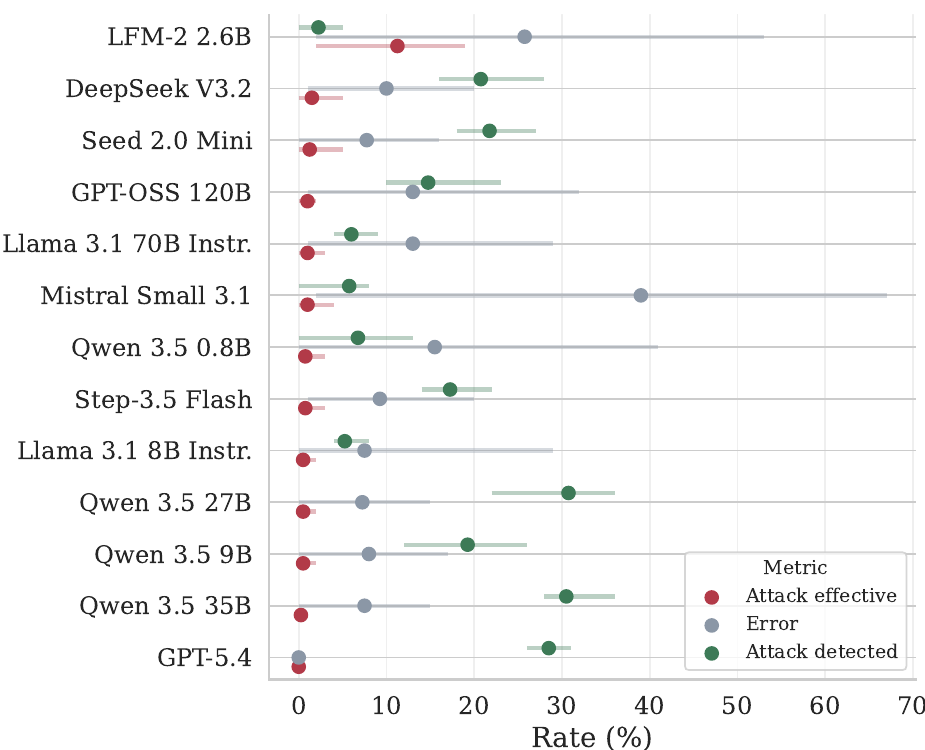
That's the same GPT-5.4 that Gray Swan fooled about 1 time in 3 in April. The difference is the attacker:
Gray Swan's red-teamers tune their attacks and get 100 tries, while a web injection is a fixed template
with one shot. Anthropic says as much: simple attacks do not succeed anymore
(Opus 5.5 System Card, p. 123).
For now, the lab tests are the harder bar. Two caveats: some models
spotted an injection and followed it anyway,
and the authors expect attacks to become
more adaptive and targeted.
What about targeted attacks that never touch the web?
Most software doesn't read the open web, but anything a user can supply still reaches the model. Measuring Real-World Prompt Injection Attacks in LLM-based Resume Screening (USENIX Security 2026) checked about 200,000 real resumes from a hiring platform. About 1% hid an injection, and the number keeps rising. Most of them weren't instructions at all, and 9 in 10 were just hidden data, like invisible lists of skills meant to game keyword matching.
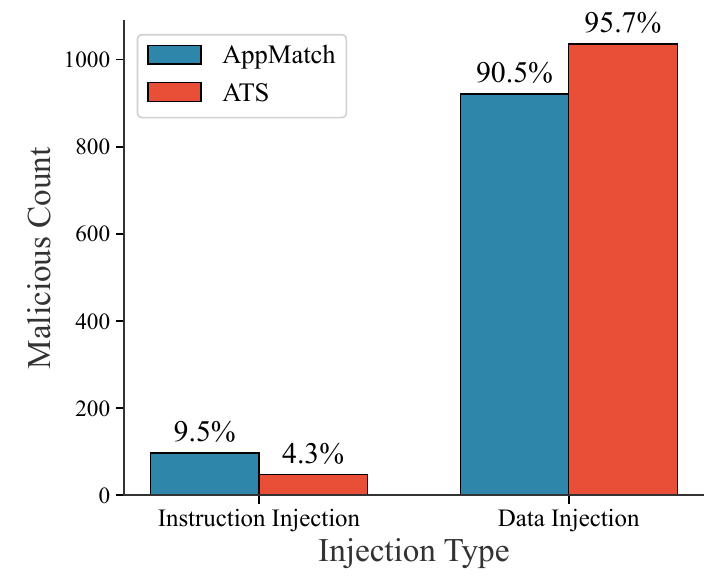
The paper didn't test whether these worked.
Takeaway
Real injections are out there and growing, but for now they're crude, and frontier models mostly ignore them. Your software doesn't need to browse the web to be exposed.
So, have real attackers used it yet?
Yes. Two reports from September 2026, one from Anthropic and one from Google's threat intelligence team (GTIG), describe criminals using prompt injection against real companies. Every group they name was after money. Neither report shows government hackers doing it.
Who used it, and for what
| Attacker | When | What they did | What they got or wanted |
|---|---|---|---|
| GTG-50020 Anthropic · Russian-speaking criminals | Dec 2025 – Aug 2026 (no exact date); reported 10 Sep 2026 | Slipped instructions into an AI company's automated testing sandbox, which then handed over the keys it held. | The company's live AI API keys. They then went after about 30 AI companies in four days, trying to reach an unreleased Claude model. That failed, and Anthropic itself was never breached. |
| Several unnamed groups Anthropic | Dec 2025 – Aug 2026 (no exact date); reported 10 Sep 2026 | Used prompt injection on AI apps built on LiteLLM, a popular tool for connecting to AI models. | The apps' live API keys. Anthropic lists this among common criminal attacks. |
| UNC6780 (TeamPCP) GTIG · criminals | Active since March 2026 (no date for the injection tricks); reported 8 Sep 2026 | Poisoned popular code packages, then hid instructions in project folders
(.claude/, .vscode/, .cursor/) that
told coding assistants to run the attacker's scripts. | Passwords and keys, which they sold or passed to extortion gangs. In one case, a gang took a copy of a company's private AI code. |
TeamPCP also used it against defenders. Its malware starts with fake "SYSTEM OVERRIDE" text asking for weapons instructions, likely so AI security scanners refuse to read on and miss the malicious code below.
Conclusion: is indirect prompt injection still a threat?
Yes, but it's shrinking fast. Newer models are much harder to fool. With 15 tries, attackers now beat Opus 5.5 about 1 time in 100.
It's still a threat when:
- the model comes from a lab with weaker defences (six were fooled 24–60% of the time)
- a request falls back to a weaker model
- the agent can reach keys and passwords
- someone finds a new kind of attack
Simple attacks mostly fail now. In Anthropic's words,
simple attacks do not succeed anymore
(p. 123).
But attackers who keep trying still get through. In Microsoft's LLMail-Inject challenge,
16.6% of teams
beat every defence stacked together. Nasr, Carlini and others broke
12 published defences, most over 90% of the time.
And in Gray Swan's competition, attackers kept breaking every model at a steady rate; the authors say even
the more robust models remain susceptible under sustained adversarial pressure
(p. 9).
All of this was on older models. On the newest ones, only the labs' own tests exist so far (Opus 5.5, GPT-6 Astra), and they rarely got through.
MCP is where the picture is least settled. The labs train and test their models on instructions hidden in tool results, and that's where the newest models hold up. But MCP gives attackers other ways in. Tool descriptions fooled GPT-5 about half the time, and neither lab's system cards test that path. So when you connect an MCP server, you're trusting what its tools say about themselves, not just what they return. The studies point to the same fixes. Limit what each tool can read and send (Parasites), check tool calls before they run (MCPTox), and enforce permissions (AgentBound), knowing they won't stop attacks that stay inside what's allowed.
Hope this helped
-- End